
What Probe Warranty Should Ultrasound Distributors Expect?





For an ultrasound distributor, a probe warranty is not a small line item buried in a quotation. It can determine whether a service contract remains profitable, whether a hospital trusts the local support network, and how quickly a difficult complaint turns into a replacement order for a competitor.
The ultrasound console may be the visible capital purchase, but the transducer is the component clinicians touch, clean, move, drop, and depend on every day. It is also one of the most failure-prone and costly parts of the system. A distributor that accepts vague wording such as “standard probe warranty” without defining coverage, process, and exclusions may inherit risks that were never priced into the business.
So, what probe warranty should distributors expect for ultrasound machines? There is no single universal term, because coverage varies by manufacturer, probe type, intended application, country, and service model. Still, a commercially workable agreement should give the distributor a clear warranty period, a realistic remedy, an auditable claims procedure, and enough detail to distinguish a manufacturing defect from damage caused during clinical use.
A probe warranty should be judged by exposure, not by its headline duration
A long warranty period sounds reassuring, but duration alone does not tell a distributor much. A two-year warranty with broad exclusions, slow technical review, and return freight charged to the distributor can be less useful than a shorter warranty backed by fast replacement and predictable approval criteria.
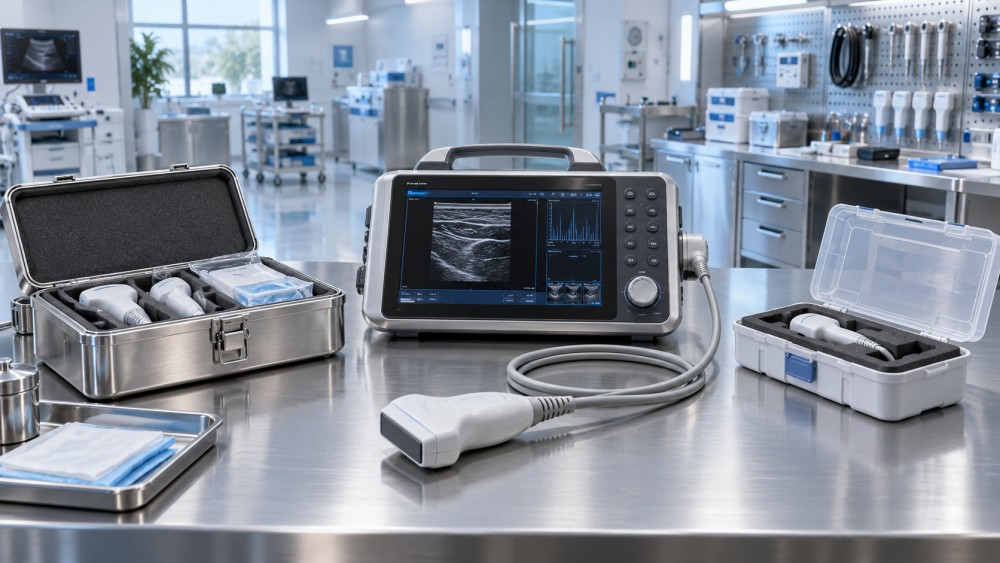
In the market, warranty terms often differ between standard convex, linear, phased-array, endocavitary, transesophageal, and specialized probes. The difference is logical. Some probes face more demanding cleaning processes, tighter handling constraints, more frequent bending of cables, or greater exposure to fluid ingress. High-frequency linear probes used heavily in musculoskeletal or vascular examinations may accumulate a high scan volume. Endocavitary and transesophageal probes introduce additional disinfection, leakage-testing, and handling considerations. A single “all probes” statement may conceal substantial differences.
Distributors should therefore ask for a warranty matrix by transducer family rather than rely on a general system warranty. The document should identify the start date of coverage: shipment date, installation date, acceptance date, or end-user invoice date. That point matters in export projects where equipment can remain in customs, in a warehouse, or awaiting site readiness for weeks or months.
It is also worth separating the manufacturer’s warranty to the distributor from the warranty the distributor promises to the hospital or clinic. If the downstream commitment is longer, broader, or faster than the upstream commitment, the distributor is self-insuring the gap. That may be a deliberate commercial choice, but it should be priced as one.
What a usable warranty agreement should actually state
The best warranty language answers practical questions before a probe fails. “Defects in materials and workmanship” is common wording, but it is only the beginning. A distributor needs to know what evidence is required, who makes the technical decision, what happens when the failure is disputed, and whether the remedy is repair, replacement, credit, or another option chosen by the manufacturer.
An important commercial detail is whether a replacement probe receives the remaining warranty period or a renewed period. Neither approach is automatically wrong, but the answer affects reserve planning. The same applies to repaired probes. A distributor should not assume that a repair resets coverage unless the manufacturer says so in writing.
Exclusions deserve more attention than the coverage statement
Most probe warranties exclude accidental damage, misuse, unauthorized repair, use with incompatible systems, improper storage, and damage caused by cleaning or disinfection methods outside the manufacturer’s instructions. Those exclusions are normal. The real question is whether they are specific enough to administer fairly.
For example, “damage due to improper cleaning” is too broad if the manufacturer has not supplied clear, current instructions for compatible disinfectants, exposure limits, drying requirements, and inspection steps. The distributor may be left arguing with a hospital after a claim is rejected, even though the end user followed a local protocol that appeared reasonable but was not listed in the instructions for use.
Probe care is especially sensitive when the transducer is used in semi-critical applications. Distributors should ensure that the approved reprocessing workflow is understood by the clinical site during installation and handover. This is not only a warranty issue. It can also affect patient safety, device longevity, and the credibility of the distributor’s training team.
Cable strain is another recurring point of disagreement. A visible kink, crushed connector, torn strain relief, or damaged lens may suggest external handling damage, but visual evidence does not always establish the root cause. The agreement should explain whether the manufacturer will provide a written technical assessment, photographs, or diagnostic findings when rejecting a claim. Without that discipline, the distributor has little basis for communicating a difficult decision to the customer.
Replacement policy matters more in clinical reality
When a facility loses its primary abdominal or linear probe, the operational consequence can be immediate. A small clinic may postpone appointments; a larger hospital may shift workload to another room, but still expect a rapid remedy. The issue is not merely whether a probe is eventually repaired. It is whether the distributor can protect continuity of service while the claim is being reviewed.
A mature manufacturer may offer advance replacement in certain markets or for certain accounts, but distributors should not assume it is standard. Ask whether a replacement unit is new, refurbished, or functionally equivalent; whether the customer must return the failed probe before shipment; and whether stock is held regionally. If regional stock does not exist, customs clearance and transport lead time can turn a technically valid warranty into a prolonged service event.
For distributors selling into remote regions, it is often sensible to evaluate a small loaner pool or local buffer stock for high-volume probe types. That decision depends on installed base, sales volume, capital tied up in inventory, and the ability to maintain traceability. It should not be made simply because a manufacturer brochure mentions “fast support.”
Do not overlook local regulatory and import realities
A warranty replacement can create regulatory and customs questions even when no payment is involved. In some markets, the replacement device may need to be linked to the original import record, local registration, or serial-number documentation. A returned failed probe may also require paperwork showing that it is being exported for evaluation or repair rather than sold.
The correct process depends on the jurisdiction, the device classification framework, and the roles of importer, authorized representative, manufacturer, and distributor. It should be checked with local regulatory and customs specialists rather than handled informally. In a cross-border medical equipment business, the warranty policy and the logistics workflow need to match.
Distributors should also check whether the manufacturer expects returned probes to be cleaned, disinfected, decontaminated, or accompanied by a declaration before shipping. This is a practical safety requirement. Sending a clinically used probe back without proper handling documentation can delay assessment and expose staff in the logistics chain to unnecessary risk.
Build warranty discipline into the sales and installation process
Many warranty disputes are created before the first scan. A quotation may list “three probes included” but fail to record exact probe models, serial numbers, intended applications, delivery condition, and warranty start date. Months later, nobody can easily determine whether a reported transducer was originally supplied with that system or whether it was moved between sites.
A practical distributor file should include the system and probe serial numbers, installation or acceptance record, end-user contact, training acknowledgment where applicable, relevant cleaning guidance, and a clear channel for reporting image artifacts or physical damage. If the manufacturer provides probe testing or diagnostic guidance, local technical staff should know how to collect the required evidence without overpromising a diagnosis.
This is also where distributors need consistency between sales language and service language. Sales teams sometimes describe a warranty as “full coverage” when the written terms contain standard exclusions. That phrase may win a conversation, but it creates a much larger problem when a dropped probe or chemical-damaged lens is later declined. Clear wording at the point of sale is cheaper than a goodwill replacement after the fact.
Questions to settle before signing a supply agreement
Before committing to an ultrasound brand, distributors should obtain the current warranty policy, not an old brochure or informal email summary. They should also ask whether terms differ by country, tender project, private clinic sale, or product generation. A policy that works for a direct domestic sale may not be sufficient for a distributor managing export freight, installation partners, and local service obligations.
- Which probe models are covered, and are any specialized transducers subject to different terms?
- What exact evidence is required to open a claim, and who has final approval authority?
- How are image-quality issues assessed when there is no obvious external damage?
- Is advance replacement available, and what conditions trigger it?
- Who bears outbound and return freight, insurance, customs handling, and disposal costs?
- Can local engineers perform approved inspections or limited repairs without voiding coverage?
- What training and cleaning documentation must be provided to customers?
These questions are useful not only for contract negotiation but also for comparing manufacturers. In medical imaging, the lowest initial equipment price can be misleading if probe claims are slow, opaque, or operationally expensive. Warranty quality is part of the total cost of supporting an installed base.
A sensible benchmark for distributors
A distributor should expect more than a warranty duration printed on a sales sheet. The minimum workable standard is a written policy that identifies covered probes, coverage start date, exclusions, claim evidence, repair or replacement remedy, turnaround expectations, freight responsibility, and the treatment of replacement units. Where clinical downtime matters, access to loan equipment or an advance-exchange path should be discussed openly rather than assumed.
For companies tracking ultrasound supply conditions across markets, warranty terms are also a useful indicator of how a manufacturer supports its channel. MTP-Intelligence follows medical imaging, healthcare equipment trade, regulatory developments, and supply-chain changes because these operational details often shape market performance as much as product specifications do. A probe warranty will not prevent every service issue, but a clear one gives distributors a defensible process when the pressure is highest.
Related News
- What Probe Warranty Should Ultrasound Distributors Expect?Oct 14, 2026What probe warranty should distributors expect for ultrasound machines? Explore coverage, exclusions, replacement policies, and claim processes to reduce risk and protect service profitability.
- FDA Tightens 510(k) Filing for AI Imaging ModulesJul 14, 2026FDA Tightens 510(k) Filing for AI Imaging Modules: learn how the new FDA rule impacts AI imaging submissions, validation packages, pending 510(k) reviews, and launch timelines.
- Lead Glass for Imaging Rooms: Compliance Checks Buyers Should Confirm Before InstallationJul 13, 2026A standards-focused buyer guide for evaluating lead glass in imaging rooms, shielding windows, documentation, installation, and acceptance checks.
- How to Choose Imaging Accessories for CT: Compatibility, Safety, and Workflow FactorsJul 12, 2026Imaging accessories for CT directly affect compatibility, safety, image quality, and workflow. Learn how to choose the right options to reduce risk and improve department performance.
Related News
- 00
0000-00
Medical Imaging Trends Shaping Diagnostic Investments in 2026 - 00
0000-00
Dental Laser Systems: When the Upgrade Delivers Real Clinical Value - 00
0000-00
Smart Hospitals Technology Trends Shaping Care Delivery in 2026 - 00
0000-00
Precision Medical Imaging in 2026: Performance Trends That Matter - 00
0000-00
Clinical Integration Solutions for Hospitals: Reducing Data Gaps and Workflow Risk
Author :
Industry Global
Weekly Insights
Stay ahead with our curated technology reports delivered every Monday.