
Why Do Pulse Oximeter Readings Become Unstable?





Unstable pulse oximeter readings are not always a sign that oxygen saturation is rapidly changing. In many cases, fluctuating SpO2 values reflect a weak, distorted, or intermittently detected pulse signal rather than a true change in arterial oxygenation. The practical challenge is distinguishing measurement artifact from a clinically meaningful deterioration before decisions are made from the displayed number.
A pulse oximeter estimates arterial oxygen saturation by transmitting red and infrared light through, or reflecting it from, perfused tissue. It identifies the pulsatile component of blood flow and uses the changing absorption pattern to calculate SpO2. This method is fast and noninvasive, but it depends on stable optical contact, sufficient peripheral blood flow, and an algorithm that can separate arterial pulsation from motion, ambient light, venous blood, and other interference.
When any of those conditions are compromised, the device may display values that jump between readings, drift unexpectedly, intermittently lose a value, or show a saturation figure that does not fit the patient’s overall condition.
The first question: is the oxygen level changing, or is the signal poor?
True changes in oxygen saturation can occur, especially in patients with respiratory disease, sleep-disordered breathing, pulmonary infection, airway obstruction, sedation-related hypoventilation, or unstable circulation. A real decline is more credible when it is sustained, occurs alongside a consistent pulse waveform or signal-quality indicator, and is supported by clinical signs such as respiratory distress, cyanosis, altered mental status, or a corresponding change in other monitored parameters.
By contrast, a reading that moves abruptly over a few seconds, disappears when the hand shifts, or changes substantially while the pulse-rate display is erratic should be treated as a signal-quality problem until checked. A pulse oximeter cannot compensate indefinitely for poor optical data. A precise-looking number is not necessarily a reliable measurement.
The displayed pulse rate offers a useful cross-check. If the oximeter pulse rate does not broadly agree with an ECG-derived heart rate, a palpated pulse, or another reliable monitor, the SpO2 value may also be unreliable. The plethysmographic waveform, where available, can be more informative than the saturation number alone: a regular, well-defined waveform generally supports a usable signal, while a small, irregular, or unstable waveform indicates caution.
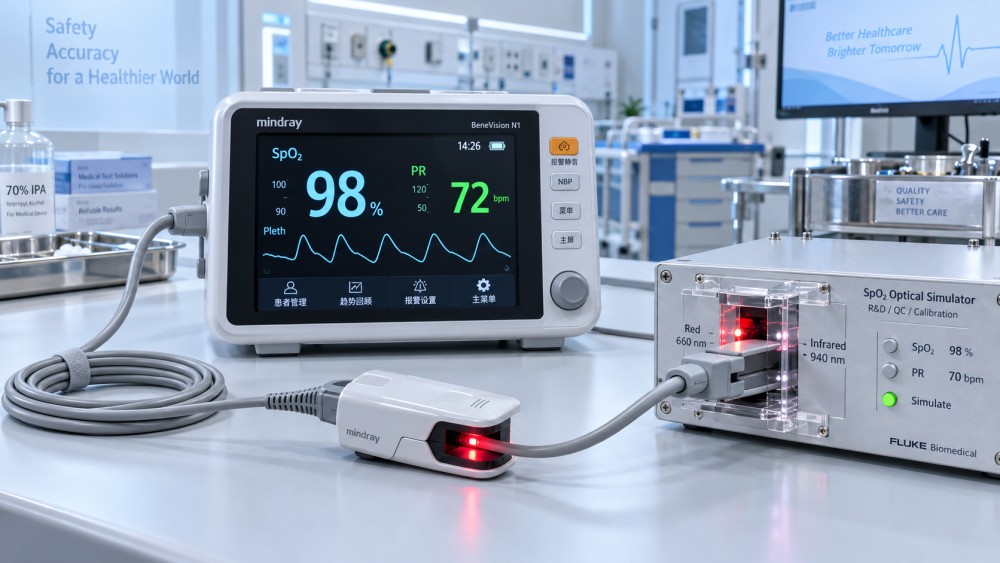
Motion artifact is a common cause of rapidly fluctuating values
Motion changes the relationship between the sensor and the tissue, and it can introduce optical variations that resemble pulsatile blood flow. Hand tremor, shivering, seizures, restlessness, transport, coughing, repetitive finger movement, and even a loosely attached sensor can all disrupt the calculation. In infants and uncooperative patients, motion is often the dominant reason for intermittent alarms or unstable readings.
The effect depends on both the patient and the device. Some oximeters use signal-processing methods designed to improve performance during motion, but these systems still have operating limits. “Motion tolerant” should not be interpreted as “motion proof.” Severe movement may lead to inaccurate values, delayed recognition of a real desaturation event, or a failure to produce a reading.
The immediate response is not to accept the lowest value shown during movement. Stabilize the monitored site, reduce patient movement where clinically appropriate, confirm that the sensor is secure without excessive pressure, and observe whether the pulse waveform and numerical display settle. If instability continues, moving the sensor to a better-perfused location may be more effective than repeatedly repositioning it on the same finger.
Low perfusion reduces the usable signal
Pulse oximetry relies on detecting small pulsatile changes in arterial blood volume. In low-perfusion states, that pulsatile component can become too weak for reliable analysis. Cold extremities, vasoconstriction, hypotension, shock, dehydration, peripheral vascular disease, heart failure, hypothermia, and the use of vasoconstrictive drugs can all reduce peripheral signal strength.
A patient may have an adequate central oxygen level while a fingertip sensor struggles to obtain a stable signal. This does not mean the oximeter is defective; it means the measurement site is unsuitable under current circulatory conditions. Warming the hand, selecting a different finger, or using an alternative sensor site may improve acquisition. Depending on the patient population and the device’s instructions for use, forehead, ear, or other approved sensor configurations may provide a more stable signal than a cold, poorly perfused finger.
Site selection must remain device-specific. A reusable clip sensor, disposable adhesive sensor, and reflectance sensor do not necessarily have the same validated anatomical locations or performance characteristics. Using a sensor outside its specified application can create an apparent measurement problem that is actually a compatibility or use-condition problem.
Sensor placement is more consequential than it appears
Poor placement can cause unstable readings even in a patient with normal perfusion and no movement. For a transmissive finger sensor, the light emitter and detector must align across tissue with sufficient perfusion. A sensor placed too far forward, tilted on the finger, partially detached, applied over an unsuitable digit, or compressed by swelling can produce weak or inconsistent measurements.
Sensor pressure also matters. A clip that is too loose may move with normal hand motion. One that presses too firmly can reduce local perfusion, especially in fragile tissue or compromised circulation. Adhesive sensors should be applied smoothly, with the optical components correctly aligned and the cable arranged so that tension does not pull on the sensor during use.
Incorrect sensor size is another preventable issue. Adult, pediatric, neonatal, and specialty sensors are designed around different tissue dimensions, optical paths, and clinical use conditions. An adult clip on a very small digit, or an improvised placement not supported by the manufacturer, can yield unstable or implausible results. Reusable sensors also deserve inspection for cracked housings, weakened hinges, cloudy optical windows, damaged cable insulation, or connector wear.
Ambient light, pigments, and external materials can interfere
Strong external light can reach the detector and affect the optical signal. Surgical lights, phototherapy equipment, direct sunlight, and other intense light sources are more likely to create problems when the sensor fit is already poor. Shielding the sensor from external light may help, but shielding is not a substitute for correcting placement or choosing a suitable site.
Nail polish, artificial nails, heavy staining, dirt, dried blood, and some topical materials can interfere with light transmission through a fingertip. Their effect is not identical across colors, formulations, devices, and patient conditions, so the practical response is to remove the interfering material when feasible or use an approved alternative site. It is unwise to assume that a stable number is automatically valid simply because the sensor can obtain a display through a covered nail.
Skin pigmentation has also received appropriate scrutiny in pulse oximetry. Performance can vary under some conditions, particularly at lower oxygen saturation ranges, and the direction or extent of discrepancy cannot be safely inferred from one individual case. This is not mainly a cause of rapidly jumping values; it is more relevant to the possibility of systematic error or reduced accuracy in a reading that appears stable. When the result conflicts with the clinical picture, confirmation by an appropriate reference method may be necessary.
Arrhythmias and venous pulsation can complicate signal interpretation
Irregular cardiac rhythms can make the pulsatile signal variable from beat to beat. In atrial fibrillation or frequent ectopic beats, for example, peripheral pulse amplitude may fluctuate enough to affect pulse detection and display stability, particularly when perfusion is already limited. The oximeter may continue to provide useful information, but values should be interpreted with closer attention to waveform quality and trend behavior.
Venous pulsation can also distort the optical measurement. This may occur when a sensor is applied too tightly, when there is local venous congestion, or in certain clinical conditions where venous blood volume changes are pronounced. Because pulse oximeters are intended to identify arterial pulsation, a stronger-than-expected venous component can interfere with the underlying assumption of the calculation.
These situations illustrate why a stable connection between the device and patient does not guarantee a stable physiological signal. The number must be interpreted in the context of perfusion, rhythm, sensor location, and clinical status.
Some conditions change what the oximeter is able to measure
Conventional two-wavelength pulse oximeters estimate functional oxygen saturation based on the behavior of oxyhemoglobin and deoxyhemoglobin. They have recognized limitations in the presence of dyshemoglobins. Carboxyhemoglobin may cause conventional devices to overestimate oxygenation because its light absorption characteristics can be misinterpreted. Methemoglobinemia can drive readings toward a limited range that may not reflect the patient’s actual oxygen-carrying status.
These are not ordinary user errors, and reapplying the probe will not resolve them. Suspected carbon monoxide exposure, methemoglobinemia, or an unexplained mismatch between pulse oximetry and patient condition requires clinical evaluation using appropriate laboratory co-oximetry or other indicated diagnostic methods.
Severe anemia presents a related interpretive issue. Pulse oximetry estimates the proportion of hemoglobin that is oxygenated; it does not measure total hemoglobin concentration or oxygen content. A patient can have a seemingly acceptable SpO2 while having impaired oxygen delivery because the amount of hemoglobin is low. Conversely, a fluctuating oximeter does not by itself establish anemia or a respiratory problem.
Why inexpensive devices may appear unstable even under ordinary conditions
Device quality affects how well an oximeter manages weak signals, motion, changing perfusion, and environmental interference. The difference is not simply whether a device can display an SpO2 number. It concerns the quality of the optical components, signal-processing design, alarm behavior, sensor fit, repeatability, and the evidence supporting the stated accuracy range.
For professional use, buyers should examine whether the device is intended for the proposed setting and patient population, whether the supplied sensor is compatible with the monitor, and whether the manufacturer provides clear performance specifications and instructions for use. Accuracy claims should be read carefully. A stated accuracy figure is usually tied to defined test conditions and a specified saturation range; it is not a guarantee that every reading in every clinical circumstance will fall within that margin.
Pulse oximeters intended for medical use are commonly evaluated against applicable standards, including ISO 80601-2-61 for pulse oximeter equipment. Conformity documentation, regulatory status in the destination market, traceable product identification, and post-market support matter because measurement reliability is not solely a factory specification. It also depends on sensor replacement availability, maintenance instructions, software control where relevant, and the ability to investigate recurring field complaints.
A consumer wellness device, a spot-check handheld unit, and a continuous bedside monitor should not be assumed to have equivalent clinical performance or alarm reliability. Procurement decisions should start with the required use case: intermittent screening, home observation under clinical guidance, ambulance transfer, ward monitoring, operating room use, neonatal care, or high-acuity monitoring impose different demands on sensor options, alarm systems, connectivity, cleaning procedures, and performance under difficult signal conditions.
A practical response when readings become unstable
Before treating a fluctuating value as a physiological emergency, verify the measurement conditions without delaying care where the patient appears unwell. Check that the patient is still, the sensor is correctly positioned, the monitored tissue is warm and adequately perfused, and the cable or housing is undamaged. Review the displayed pulse rate and waveform or signal-quality indicator. Remove obvious optical interference and reduce direct external light.
If the number remains inconsistent, compare the reading at another approved site or with another properly maintained device. A repeatable difference between devices does not automatically identify which device is correct; it identifies a need to examine sensor type, placement, validation status, and patient-specific limitations. In clinical settings, an unexpected or consequential value should be assessed alongside the patient and, when indicated, confirmed through arterial blood gas analysis or co-oximetry rather than resolved by repeated finger measurements alone.
For fleets of devices, recurrent instability should trigger a structured review rather than informal replacement. Useful checks include whether the issue is concentrated in a particular sensor batch, monitor model, use location, patient group, cleaning process, or environmental condition. A pattern of unstable readings after repeated disinfection, for example, may indicate sensor degradation or incompatibility with cleaning practices. A pattern limited to transport may point to motion, cable strain, or poor perfusion during movement rather than an algorithm fault.
Reliable pulse oximetry depends on conditions, not just equipment
The most important operational principle is simple: pulse oximetry is a signal-dependent measurement, not a direct measurement of arterial oxygen content. Unstable readings often arise because the device cannot isolate a clean arterial pulse at the chosen site. Correcting motion, placement, perfusion, and sensor condition resolves many problems. When a value remains unstable or conflicts with the patient’s condition, it should be treated as uncertain information—not as a number that becomes trustworthy merely because it is displayed.
That distinction improves both clinical safety and equipment evaluation. It prevents avoidable alarm fatigue, reduces the risk of acting on artifact, and directs attention to the cases where unstable readings may reflect a genuine change requiring prompt assessment.
Related News
- Smart Thermometer Accuracy: Key Checks Before Home or Clinical UseJun 03, 2026Smart Thermometer accuracy matters—learn quick checks for calibration, sensor cleanliness, positioning, battery, and environment before home or clinical use.
- Defibrillator Maintenance Checklist to Reduce Failure RiskMay 31, 2026Defibrillator maintenance made practical: follow a clear checklist to reduce failure risk, verify batteries, pads, testing records, and keep devices emergency-ready.
- Portable Blood Glucose Meters: How to Compare Accuracy and Test Strip CostsOct 15, 2026Compare portable blood glucose meters for accuracy, test strip costs, and everyday ease of use. Discover how to choose a reliable system that fits your needs and long-term budget.
- Why Do Pulse Oximeter Readings Become Unstable?Oct 18, 2026Why do pulse oximeter readings become unstable? Discover key causes—from motion and low perfusion to sensor placement—and practical steps for more reliable SpO2 monitoring.
Related News
- 00
0000-00
Medical Imaging Trends Shaping Diagnostic Investments in 2026 - 00
0000-00
Dental Laser Systems: When the Upgrade Delivers Real Clinical Value - 00
0000-00
Smart Hospitals Technology Trends Shaping Care Delivery in 2026 - 00
0000-00
Precision Medical Imaging in 2026: Performance Trends That Matter - 00
0000-00
Clinical Integration Solutions for Hospitals: Reducing Data Gaps and Workflow Risk
Author :
Industry Global
Weekly Insights
Stay ahead with our curated technology reports delivered every Monday.