Global Medical Technology Intelligence Hub

What training is needed before selling flow cytometers?





What training is needed before selling flow cytometers? A sales representative needs more than a product presentation. Effective preparation combines basic flow cytometry principles with hands-on product training, an understanding of laboratory workflows, and clear knowledge of the intended use and support available in each market.
The goal is not to turn every salesperson into a laboratory scientist. It is to recognize what a customer needs, discuss the limits of a proposed system, and know when to involve an applications specialist, service engineer, or regulatory colleague.
Start with the science behind the purchasing decision
Flow cytometers measure characteristics of cells or other particles as they move through a fluid stream past one or more light sources. Detectors capture scattered light and, when fluorescent markers are used, fluorescence signals. Software then displays the data so laboratory users can identify and examine populations of interest.
A sales team does not need to master every experimental technique, but it should understand enough to explain how an instrument configuration relates to an application. Training should cover:
- Light scatter: How scatter measurements provide information related to particle properties, and why they do not identify a cell type on their own.
- Fluorescence: How fluorescent markers help users study selected cell characteristics, and why the available lasers and detectors matter.
- Panels and signal overlap: Why combining markers requires attention to their optical properties and why compensation or other analytical methods may be needed.
- Data interpretation: The purpose of controls, gating, and quality checks, without presenting the instrument as a source of automatic clinical conclusions.
This foundation helps prevent a common sales mistake: treating the number of lasers or detectors as a complete measure of suitability. A laboratory may need a particular combination of markers, a defined workflow, or room to expand later. The right configuration depends on those requirements, not on the largest specification on a brochure.
Learn the specific instrument, including its limits
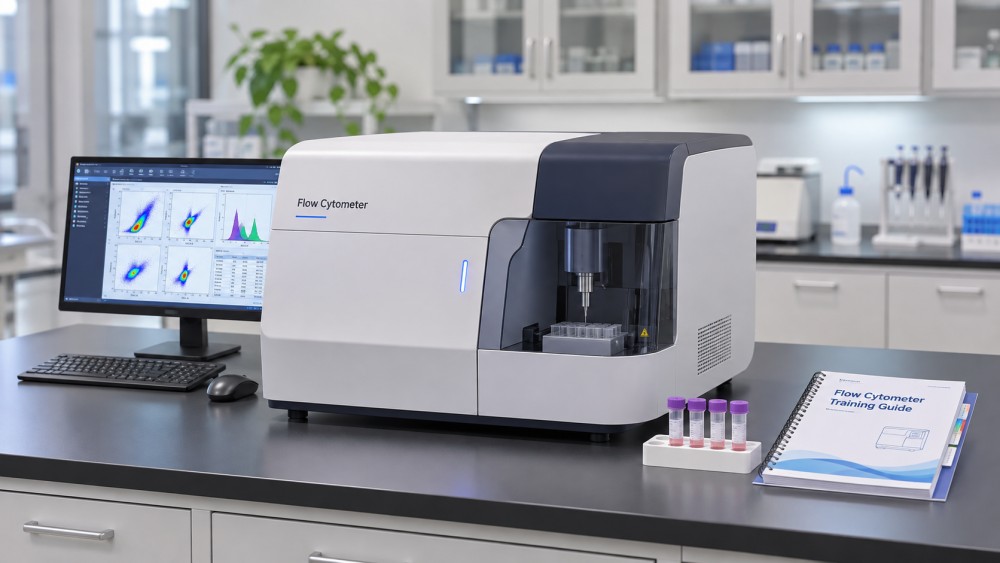
Manufacturer-led product training should explain the configurations available in the territory, the differences between them, and which accessories and software options are included or sold separately. Salespeople should be able to trace a customer requirement to a documented capability rather than relying on a general statement such as “the system can handle complex panels.”
For example, if a laboratory wants to run an existing fluorescence panel, the team should gather the marker and fluorochrome details and involve an applications specialist in assessing compatibility. Detector count alone does not establish that a panel will work well: laser excitation, detection configuration, signal overlap, controls, and the intended analysis all matter.
Training should also cover sample loading options, data management, routine quality-control tools, supported consumables, and any dependencies between hardware and software. If a system offers automation, the salesperson should understand which steps it automates and which still require operator preparation or review.
Some customers will ask about cell sorting. An analyzer measures particles; a cell sorter can also physically separate selected populations. These are different capabilities, with different infrastructure and support considerations. Staff should not imply that an analytical instrument can sort cells unless that capability is part of the specified system.
Understand the laboratory workflow before recommending a configuration
The same instrument can be a good fit for one laboratory and a poor fit for another. Training should therefore include a practical walkthrough of the work surrounding the cytometer: sample preparation, instrument startup and quality control, acquisition, analysis, reporting, cleaning, and shutdown. These steps help the sales team identify requirements that are easy to miss when a discussion focuses only on hardware.
A research laboratory developing new panels may value configuration flexibility, access to analytical tools, and support with method development. A clinical laboratory may focus more on intended use, validated workflows, documentation, traceability, and dependable service. Those are different conversations, even when both customers are considering flow cytometry.
Before preparing a quotation or demonstration, a representative should be comfortable asking:
- What samples and applications will the laboratory work with, and are they for research or clinical use?
- What markers or existing panels must the system support?
- How many samples does the laboratory expect to process, and how are they currently handled?
- Who will prepare samples, operate the instrument, analyze results, and maintain the system?
- What space, utilities, data systems, and support resources are available?
- Does the laboratory expect its applications or workload to change?
These questions are a starting point, not a substitute for a technical assessment. A useful outcome is a written account of the intended workflow and unresolved questions that the manufacturer or applications team can review before the proposal is finalized.
Practice demonstrations and application discussions
Classroom instruction should be followed by supervised product exposure. A representative benefits from seeing a routine startup, quality-control check, sample acquisition, basic data display, and shutdown. Observing the full sequence makes it easier to explain operator responsibilities and spot where a customer may need additional training.
A demonstration should be planned around the laboratory’s stated application. Agree on what will be shown, which samples and reagents will be used, and what questions the session is meant to answer. If the customer wants to evaluate an existing panel, the applications specialist should discuss preparation and acceptance criteria in advance.
Sales staff should also learn what a demonstration can and cannot establish. A successful demonstration may show that a workflow is feasible under the conditions used. It does not by itself validate the customer’s entire method or guarantee equivalent results for every sample. Laboratory validation and any clinical interpretation remain with the appropriately qualified users.
Role-playing is useful here: one person presents a realistic customer requirement, while another practices asking follow-up questions and explaining when specialist input is needed. This exposes gaps in product knowledge before they affect a live opportunity.
Know what can be claimed in each market
Flow cytometers and associated software, reagents, or assays may be supplied for different intended uses. The relevant requirements depend on the product, its claims, and the market in which it is offered. A research-use configuration should not be promoted as suitable for clinical diagnosis simply because a customer works in a hospital laboratory.
Training should give sales teams access to the current materials authorized for their territory, including product labeling, intended-use statements, and approved promotional claims. They should understand how to handle requests for performance information, documentation, or clinical-use claims that fall outside those materials.
Responsibilities also need to be clear within the supply chain. Depending on the arrangement and jurisdiction, a distributor may have obligations relating to product records, complaint handling, traceability, storage, or communication of safety information. The manufacturer and distributor should establish who performs each task and how issues are escalated.
Salespeople do not need to interpret every regulatory requirement themselves. They do need to recognize when a question concerns intended use, market authorization, or a product change and route it to the responsible regulatory team before making a commitment.
Cover installation, service, and ownership costs
A laboratory buys more than an instrument. It also needs a workable plan for installation, user training, consumables, maintenance, software, and support. If those elements are left until after the sale, an apparently suitable system can become difficult to operate or budget for.
Product training should explain the site preparation process: space and access, electrical and environmental needs, computing and network arrangements, and any other requirements specified for the configuration. The salesperson should know who conducts the site assessment, who installs the system, and what the customer must prepare beforehand.
For cost discussions, distinguish the initial quotation from ongoing ownership. Depending on the system and workflow, recurring items may include reagents, controls, cleaning supplies, consumables, preventive maintenance, repairs, software, and user training. Ask about expected usage before estimating consumption; a figure based on a different workload may be misleading.
Service training should also make boundaries explicit. A representative should be able to explain how customers request help, what support is included, and when an issue requires an applications specialist or service engineer. Promises about response times, replacement instruments, or parts availability should reflect the actual local service agreement.
Build competence around roles, then check it in practice
Not everyone involved in a sale needs the same depth of training. A sales representative may focus on qualification, product positioning, and commercial discussions. An applications specialist needs deeper knowledge of experimental workflows, demonstrations, and customer training. A service engineer requires the technical preparation and authorization relevant to installation, maintenance, and repair.
For a new sales representative, a practical preparation sequence is:
- Complete introductory training in flow cytometry and common applications.
- Attend manufacturer training on the product range, configurations, intended use, and approved claims.
- Observe a demonstration and the main stages of routine instrument operation.
- Practice qualifying an opportunity and preparing a proposal with an applications specialist.
- Review installation requirements, service arrangements, and recurring cost categories.
- Learn the internal routes for technical questions, complaints, and regulatory issues.
Readiness is better assessed through a realistic discussion than through a certificate alone. Can the representative describe the customer’s workflow, identify the proposed configuration and its assumptions, explain the available support, and recognize questions that need escalation? If not, additional coaching or joint customer visits are more useful than expecting independent product expertise immediately.
Training should continue when the manufacturer changes software, configurations, labeling, or support processes. Keeping an accessible record of completed courses and current product materials helps the team maintain consistent answers as its portfolio and markets change.
Got questions about this industry topic or seeking best practices for your business? Drop us a line below, and let the expert team at Indu Streamline help you out.
We respect your privacy. Your information is strictly confidential.
Related News
- Diagnostic Testing Equipment Selection: Cost, Throughput, and Maintenance RisksJun 01, 2026Diagnostic Testing Equipment selection guide: compare cost, throughput, reagent strategy, and maintenance risks to reduce downtime and make smarter buying decisions.
- What training is needed before selling flow cytometers?Nov 09, 2026What training is needed before selling flow cytometers? Explore essential science, product, compliance and sales skills to confidently guide buyers.
- Siemens Healthineers Starts Diagnostics Separation and Plans RenameNov 06, 2026Siemens Healthineers starts its diagnostics separation and plans a rename. Explore potential implications for procurement, compliance and support.
- Roche Secures CE Certification for New Mesothelioma Diagnostic TestOct 29, 2026Explore Roche's reported CE certification for the VENTANA BAP1 (SP527) mesothelioma diagnostic test, including intended use and key checks for laboratories and procurement teams.
Related News
- 00
0000-00
Medical Imaging Trends Shaping Diagnostic Investments in 2026 - 00
0000-00
Dental Laser Systems: When the Upgrade Delivers Real Clinical Value - 00
0000-00
Smart Hospitals Technology Trends Shaping Care Delivery in 2026 - 00
0000-00
Precision Medical Imaging in 2026: Performance Trends That Matter - 00
0000-00
Clinical Integration Solutions for Hospitals: Reducing Data Gaps and Workflow Risk
Author :
Lab Diagnostics Label
Weekly Insights
Stay ahead with our curated technology reports delivered every Monday.